Special thanks to Nikola Urošević for the exclusive right to publish the original interview in English.
Serbian sources:
1. http://www.dobrevibracije.org/Section/vesti/2010/05/01_trey%20spruance.html
2. https://www.yumetal.net/forum/topic/38209-secret-chiefs-3/page/3/
– How did the last European tour go? What are your expectations about the forthcoming tour? Have you ever been to Balkans/Serbia before?
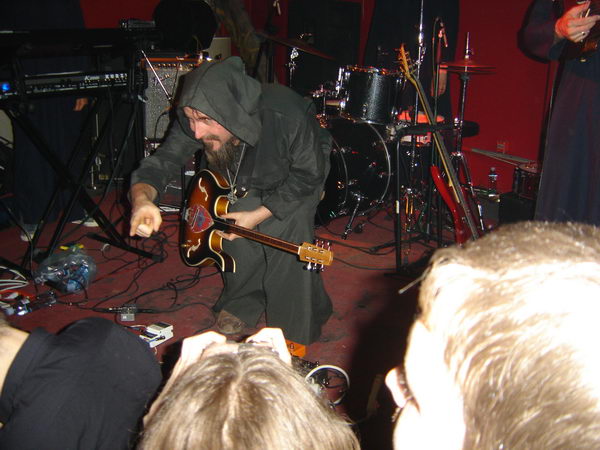
The last two tours in western Europe have been good for us. We learned that France is a good home base for us in the EU, and from there we can branch out to the rest of Europe and beyond. Yes, when we started this interview I was saying “we intend to play in Eastern Europe in 2010!” But now it’s happening! For many reasons I think it’s important for a band like us to go to places like Romania, Serbia, Turkey, etc. We have no illusions (yeah, I have traveled in a lot of these places on my own, but never Serbia yet — I’m really excited about it!!!). I feel motivated that at least some of the music coming from the Anglo/American/EU type of mindset should reflect SOME higher dimensions than party, sex, get rich, do drugs, oh screw it all / I don’t care let’s rock, etc. It’s such a boring prison of the mind and heart… and I see clearly how this attitude is infesting and trapping the world everywhere, to make everyone it’s slave by saying ” liberate yourself! Join the pointless party of bullshit! It’s so much ‘fun’ ! Don’t miss out on all the great times! “. Our strategy against that has always been the same from the beginning (1995). There are better things in life than these things. Let’s celebrate some of them for a change. It’s almost like it’s some shocking and heretical idea to respect the heart inside of people, wherever they are, and NOT expect them to change into unquestioning and passive recipients of a contrived set of hedonistic values. And every country is different (no, they are NOT all the same, like some people say!). To me, the only “universal” language is to agree on what is ‘higher’ and what is ‘lower’, and at this point, unfortunately, that can mostly be done only through ‘feeling’. The brains have been programmed another way. Thus, most music that is exported from the west, whether it’s folk, grindcore, techno, metal, jazz, avant garde etc reflects the basic western values and suppositions: For example, the ‘feeling’ that there is no purpose to life — that you can pick and chose what to believe about what is above or below (meaning, that there is n o above or below) and it’s all the same, so you should just enjoy life, etc. We have never accepted any of that, and in fact have been fighting that imprisoning attitude from our beginning. So we are really interested to go places where that fight is actually going on on a cultural level. For sure it’s a losing battle everywhere and I have no illusions. But we come from a place where that battle has been utterly LOST for hundreds of years now… yes, though America is a “new” country, it is also the oldest cynical pseudo-democracy on earth. And SC3 are not especially trapped by this dialectical mafia-mind of the world that spreads out like tentacles from there. Partially we are, yes. It’s ambiguous, because there is very much darkness in our music too. We don’t mask it or hide it. We have to be real about the situation, otherwise we just speak lies and project an ‘ideology’! NEVER. I think this is why people can relate to the music even from some very nihilistic feelings. It’s not about projecting an ideal of hope… it’s about being squeezed like a lemon until your essence comes out — the place that all the real beauty in life always comes from… and has always come from. This is always about the choice between what’s higher and lower, the lower being easy, the higher being difficult. When you are supposed to be distracted by a different “choice”, such as the infinite tension of a choice between Coke or Pepsi, or Obama or Bush, as if you very life depends upon such things — as if those constitute a choice between higher and lower — then you have fallen into the disgusting trap. We see that binary hypnosis everywhere, absolutely everywhere. What I like about SC3 coming to Eastern Europe and beyond the EU is the idea of a band that doesn’t address these issues through screaming left wing politics and social slogans etc, but perhaps from a place more vital and personal, closer to the heart.
– Let’s talk a bit about Le Mani Destre Recise Degli Ultimi Uomini. What is so fascinating about giallo music? How did you come up with the idea to put this apocalyptic concept into giallo soundtrack form ?
Giallo is such a confined format, yet allows for very complicated imagery and ideas, bound within it’s simplistic and confined format. That’s especially true for the music. These days, most people say “the soundtrack is amazing, who needs the story?”. I think the situation of Giallo film music is inherently similar to what SC3 have been doing all along. In those films you have composers fitting themselves into a tiny space and developing a language within it. SC3 as well has developed it’s language within the context of the confining space of a ‘rock’ band. And most people don’t care about “the story”. Anyway, embracing this completely, I decided to have a strong allegorical story about the immediate future, a horror movie in my mind, and not tell anyone the story. The result is Le mani destre recise degli ultima uomino. It is a tale of three sisters (one dead at the beginning) being torn in different directions by the moral choices they make in a world being reformatted by food control laws, environmental control laws, immigration control laws and RFID chips etc. Geez, what an imagination I have, huh? Where could I have possibly gotten such crazy ideas? 🙂
-Could you shed more light on this Cytherea/Sophia disposition? What do these two characters represent? Are they inspired by Argento’s “mothers” ?
Well, not directly Argento, but yes, for sure the mysterious bonds between females being the classic Giallo device is at work there. The three sisters are Sophia (the dead one), Faith and Cytherea. It is really an allegory of Love. Love in three dimensions as Agapia (Sophia), Philia (Faith) and Eros (Cytherea). Its a tragedy of the loss of Agapia (Sophia was an Orthodox nun) and the confusion that results from that absence. Faith is a struggling Catholic woman who is overly concerned with her sister Cytherea, the problem child (to say the least). Both women are deeply affected by the death of Sophia, and are in great grief. Faith tries to follow in her sister’s footsteps (and being unprepared, causes some real psychological problems for herself). She becomes obsessively “religious” but also narcissistic and arrogant. In a sense, without the purifying presence of Love on the level of Agapia/Sophia, a ‘demon’ enters through Love on the level of Philia, represented by Faith, in the form of self-love. This intuitively drives Cytherea deeper into despair and outrage. She is already emotionally disturbed, but also really smart and clever, and has always had a hard time stomaching all the religious stuff. Now, in the despair and frustration, she starts to really start to get angry & go a bit crazy. Basically she becomes completely nihilistic, hedonistic and atheistic. It worsens with her openly rebelling against her sister, who is also weak and reacts by becoming more and more fake pious. Sensing the poverty of this, eventually Cytherea becomes very open to all kinds of other forms of spirituality. The short version is that she basically becomes a drug addict, maybe even possessed (Faith thinks so), certainly very insane. When she finally has a psychological breakdown, Faith checks her in to a clinic that uses RFID to track patients. The rest is where the movie really takes off! It gets really scary after that! But to answer your question, yes, you could think of the three sisters as three stages or modes of love (Agapia, Philia and Eros), with the two thrown into chaos (even ‘evil’) in the absence of the primary mode.
– Also, while listening to Le mani destra recise degli ultima uomino, I couldn’t get Phillip K. Dick out of my mind – not just because of all the conspiracy stuff, but because of this science fiction/mysticism blending as well. You mention Phillip K. Dick as the important influence on your myspace page. Where exactly is his place in the universe of Secret Chiefs 3 ?
Philip K Dick was a tireless seeker of the truth who understood human nature deeply. On an individual level, he’d almost martyr himself for friends — while on a collective level he knew how to spot almost everything about the looming heart of darkness (the Empire). Seeing it, I do believe he martryed himself in his work. In that sense, and in the sense that by the end he was obsessively reading Gnostic texts, many consider him a paranoid ‘gnostic’. However, he NEVER settled on any gnostic doctrine. It didn’t fulfill him. How could it? Most people are not aware of the time he spent as a practicing Catholic, taking Eucharist etc. His Christianity did not begin in his late years as after the beam of light that necessitated Valis etc. The regenerative principles in Ubik for instance, though sheathed in technological terminology, are a description of the metaphysical fact of eucharistic regeneration. He had lived these things. And he had known extreme financial poverty and the comparative un-caring coldness of the impressive technological/ideological monstrosity we have built up around ourselves. But he wasn’t bitter and antisocial. He wasn’t full of hate and reactionary politics. Seeking understanding he quietly mastered Hellenic philosophy,ideas of civilization, literature. I guess what I’m saying is that Philip K Dick was not a technical sci-fi writer who simply developed a taste for mysticism and humanism along the way. He was a deeply spiritual metaphysical philosopher (once called a theologian when there was a place for that in the west) who bent his spiritual insights to be comprehensible to the real world he saw around him. The fact is that the technological world we live in and all the bad philosophies that attend it are just another emanation of Empire. This is true in so many ways that remain invisible to a lot of his readers. Contrary to how it’s interpreted most of the time, with him it’s not a mystification in sectarian symbolism and a blending of sci-fi and literary genres that’s going on… There is a more fundamental confrontation at work. For his tireless work in that regard, SC3 owes PKD a vast debt of gratitude that can never be re-paid.
– Do you know Alan Bishop from Sublime frequencies/Sun City girls? I really liked their approach to the ethnic/traditional music. Could you tell us something about your approach to this kind of music? What are your main ethnic/traditional influences ?
Yeah, I know Alan well! I think the first time I saw the Sun City Girls play (maybe in 1992?) might have been the first time I’d ever seen real, psychically-bonded improvisation. And it was so much larger than the sum of it’s parts, it really seemed like the walls could start warping, or the sky could open or something. Really. It was like, “if THIS is possible, what ISN’T possible?” The funniest part was that back then none of my “good musician” friends who ever saw them were ever really all that impressed… with the exception of Eyvind Kang. Anyway, I guess I don’t really have an approach to ethnic or traditional music. What I mean is, I don’t really know any traditional music. My soul definitely has a fundamental response to music in the Dastgah, Octocheos and Maqam expressions. But I am not and never have been versed in any of those traditions. What I have done is studied the tonal systems and tonal philosophies perhaps ‘underneath’ or in ‘in the background’ of each of those things. You can only learn a tradition hand to hand from a master. This is very clear. I would never even try it. Not because I don’t want to & wouldn’t like that, but because it is a life commitment, and I already am a “composer” in the western sense —which I am definitely committed to. (even if there is not any place for someone like me in the ‘arts’ scene, and I am forced to participate in the commercial ‘market’ — which I hate but shouldn’t complain because it’s been ok for me personally). So in typical western fashion, because it moves my Heart, I have spent a lot of time trying to understand the workings of the universe through my brain, and then finally through music. This has brought me to Pythagoras and Suhrawardi and a few others, and I have labored to apply their insights, while also having fun & finding ways to make relevant connections. Even making statements, sometimes heavy criticism (of hyper-modernity), or sometimes hilarious or subtle ironic things that only a few people might understand (which could just as easily involve Shostakovich and Webern or Queen, so it’s not always ‘eastern’). But all of it is orchestrated according to an overarching philosophical artifice. It’s no accident that we do use some eastern instruments that are capable of accommodating the tonalities involved in all this. But we have also re-fretted electric guitars and basses to accommodate those. That itself is hilarious, when you think about it.
– In the last couple of years there has been this great revival of psychedelic folk music, stoner rock bands suddenly turned into middle eastern gnostic ensembles, Tuvan shamans finally came out of the steppes and gypsy punks stormed the gates of civilization once again. Do you think that ethnic/traditional music nowadays needs some kind of “alternative” frame in order to communicate? Do you think that this kind of alternative (something like “alternative folk music”) could be subcultural response to the dehumanizing pressure of the modern society ?
I think so, yeah. I really hate it when I see, for example, Iranian black metal bands hailing Nordic gods, when they themselves have the national epic the Shahnameh they could use, or the Zend Avesta or something. On the first hand, I hate and regret that any people anywhere have to have a bunch of foreign values heaped upon them at all. It’s regrettable when anyone buys into it blindly and willingly, as if life will get better just because you can have a cellphone now etc… however, once the angst finally sets in about what one has traded-in in order to participate in the modern life, one of the things you can do is pick up some of these gadgets and try to build a musical culture that is not entirely subservient to the values that come attached to these gadgets. To be completely defiant towards those values, of course, places you in somewhere like a monastery. But short of that, we don’t need to accept that the bad philosophies and bad ideas that come with modernity are inherently attached to these objects that are being flung at us. To me the key is not just being defiant, like the punks in the west, but having something better to replace those pseudo-philosophies with, and expressing those things musically by every means available. So in that sense, yes. I hope musicians worldwide who feel this need for subculture will seize every opportunity to counteract the civilization of death which calls itself ‘modernity’, by asserting something far superior to it. Usually, of course, they will just assert the same old garbage about partying and such, as if that is the “universal constant” into which we are all united. That is a completely bullshit perspective, in my opinion. In fact it constitutes the essence of the hypnotic spell cast from the modernistic legacy itself, which justifies itself in the ‘progressive’ ideologies of Renaissance humanism — all of that is now coming to fruition in desire’s ‘liberation’ at the cost of the ruin of the planet, the reign of Quantity in the form of corporate overlords (oligarchy), and the sharp division of human populations into material winners and losers. It’s for this reason that I have to fundamentally reject this universal “party” mentality as being part of the problem: unbridled hedonism is the doctrine of the rich overlords of the oligarchy, and romantic identification musically with the more “small time” criminal class does not put you in a different category. It just makes you dreamer. It just shows the quality of your heart — that you accept and want to be part of that criminal oligarchy.
– Where exactly do mathematics, music and mysticism meet ?
Well, I have to confess that music, being an inherently geometrical and physical phenomenon, also has it’s invisible dimension. I think its easy to get caught by the mechanics of it. But its also easy to ignore the beauty of the mechanics, and assume that the ‘intuition’ alone can guide one to musical beauty and truth. To me, it is the interplay of the invisible and visible aspects of applied music that gives it Life. Heraclitus said “Harmony is greater Unseen than Seen”. We have to admit always that the priority belongs to the invisible aspect. And this is the aspect of the “Unlimited”, or the ‘spiral nature of harmonic progression. The aspect of the “Limited” or circular nature of harmonic progression is the aspect that is based not on nature, but on mathematics. This is where man intervenes. His creative act can either lead away from remembering the Unlimited, or toward it. You could say very specifically that Wagner leads away from that memory in a real way (but conceptualizes itself otherwise, replacing the disappeared harmonic ‘fact’ with a libretto that makes it an Ideal), while something like Classical Iranian Dasgah or Byzantine Octocheos definitely leads towards that remembrance in a demonstrably real way (meaning it goes well beyond the mathematics, even though it labors to employs correct harmonic relationships, where the other seeks to forget those relationships entirely). Our cycle of harmonic music lives somewhere between these, probably closer to Wagner to be honest, but is definitely seeking remembrance of the harmonic Unseen rather than forgetfulness of it.
– Do you think that microtones represent “natural state” of music, or are they just “atomization” of the regular scale ?
No, I don’t think the perspective of ‘atomization’ is harmonic AT ALL. The very term “microtones” is wrong. Tones are generated by nature, and the best way we can describe the parts of tones is through ratios. There is not some grid over nature by which you define how many divisions there are. Harmony is a ‘tensegrity’ — it is a tautological structure of self-supporting tension. Heraclitus conceived of it as a tension stretched back on itself. That’s completely right. His metaphor is that of opposition: of a bow and a string pulling against each other, but releasing an arrow of intent as the ‘harmonic’ reconciliation. There is no place for ‘atomization’ in this. Atomic theory applied to music can only come from artificial grids that have lost the sense of harmonic TONOS, which means stretching tension, and is the basis of our word for “tone”. When you lose that, you lose the principle of harmonic unity, and then it is of course entirely possible to become effectively “tone deaf” and doubt the existence of harmony on this level. Only in this way could one conceive of a “microtonality” as a further atomization of an essentially arbitrary 12-tone equal tempered system. That system has its reason for existing, which is based in reasonably consonnant harmonic simultaneity over infinite modulations within a chromatic system based approximately on the harmonic progression of 5ths. But any concept of atomization within that system is inherently dis-harmonic. That can be fun and interesting (I mess with it). But we shouldn’t have any illusions about it having a harmonic basis. (speaking of the serialists and later microtonal experimenters). On the other hand, figures like Messiaen and Slonimsky and even Coltrane (who borrowed heavily from Slonimsky) were certainly working with tautological harmonic / geometric principles filtered through the 12 tone grid. In their case it’s more like pixelation: there is actually a structurally sound picture behind the pixellating grid. Theirs are (often) analog back-strecthed (palintonos) harmonic universes boxed into the ‘digital’ quasi-harmonic format of western instruments. This cannot be said of, for instance, Xenakis. His universe is similarly analog (like Ligeti’s), and involves infinitely more tonal space, but is fundamentally devoid of back-strecthed self-sustaining tonos relating in any way to the actual architecture of sound (though it may ‘represent’ such tensions in the physical world of architecture, as far as sound goes, it is fundamentally dis-harmonic).
– I know that you’ve been friends with Zorn since Mr. Bungle era, you’ve performed with him on a couple of occasions, you’ve contributed to some Tzadik releases, and one of the recent Secret Chiefs 3 cd’s, Xaphan, was part of his Book of Angels series. What is it like to work with Zorn? What are your impressions on Zorniana festival in Milan two years ago ?
We had a great time at that festival! Yeah, I have to say, after knowing him 20 years I can say without hesitation that Zorn is really a fine human being. I think the word would be a much less colorful place without him: his music, his personality, his special gifts, and his ability to incorporate so many different kinds of talent to do so much in such incredibly small amounts of time. Usually Zorn pieces rely a lot on this great inspiration of the players, but his writing is so incredible, getting better and better over the years. The Masada tunes, which may seem thrown together since there is such a quantity of them, and becasue they are generally simple and modal/tonal, can seem to fall into a kind of “secondary” status writing-wise, compared to his string writing recently or the more experimental works. With Xapahan I wanted to really highlight the supreme integrity even of these simple-seeming compositions. Good writing is good writing. As an arranger you can do SO MUCH with these tunes. That’s not the case with bad writing. So I went crazy arranging the hell out of them, and I really think it shows that even these small compositions of his have extreme integrity, and are testimony to a musicianship of the highest order. Its nothing but a pleasure and honor to work with Zorn.
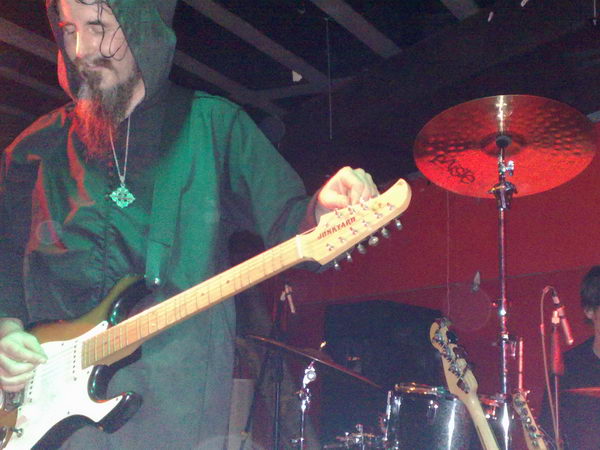
– Do you still play with Asva occasionally ?
Not recently, no. But I think Stuart is brilliant and will always come up with interesting things. I hope he continues to do Asva, or anything else, and I will always be happy to lend a hand if he wants it.
– What are you listening/reading these days ?
I’ve been reading the Philokalia and listening to some language CDs. I decided to do a few lessons of Serbian before we come there. Probably only 6 or so, so don’t expect too much! Serbian is competing in my attention with Turkish and Romanian, and I’ve been to both of those places before, so they have a head start.
-Thank you very much for the interview. Just one more question: What do you think is going to happen on 2012 (except for the Olympic games) ?
I hope what will happen is that everyone will grow out of projecting decayed, crypto-Christian apocalyptic concepts onto other cultures, and inventing comic-book scenarios out of the silent mouths of extinct ancients who are not around to tell all these white people how stupid they are being, and how wrongly they have interpreted everything (according mostly to their fantasies, dim echoes from becoming unglued from their own Traditions). But I’m not naive enough to believe that everyone will grow out of that. So, after ‘nothing’ happens, I will try to enjoy hearing all the millions of post-hoc explanations about how it was a transformative and evolutional event, like a seed that got planted than needs time to germinate, blah blah. So in that sense, something definitely will happen. The apparatus of ‘faith’ will be used in defense of a purposeless invocation, on the basis of a cartoon-like understanding of the mysteries of a murdered civilization, as a final act of colonialization: a vampirizing of their spiritual remains to engender an imaginal spectacle of a New Age crypto-Protestant apocalypse, for entertainment, before moving on to the next ancient world-end prophecy…
Kako je ovo davno bilo ovo!